Monday, 3 June 2013

Aire Sculpture Trail - Saltaire to Shipley


Aire Sculpture Trail - opened 25 May 2013


Aire Sculpture Trail

The Aire sculpture trail was officially opened on the 25th May 2013 by Andrew Mason, Managing Director of Newmason Properties Ltd., and is said to be an integral part of improving the use of the footpath alongside the river Aire between Baildon Bridge and Saltaire.

This development has been created for the benefit of residents and visitors to Saltaire and Shipley.  It adds a visitor attraction to the area and encourages the use of this footpath link.

The project is a collaboration between CBMDC Dept of Regeneration & Culture, Newmason Properties Ltd, Canals & River Trust, Hive Community Arts Organisation and Wycliffe Primary School.

Hive is a community arts organisation based in Shipley that has been delivering high quality creative activity across Bradford for the last 30 years. It commissioned metal sculptor Mick Kirkby Geddes to work with students from Wycliffe Primary School.

Under Micks supervision the children prepared drawings and then made their own sculptures inspired by their thoughts and feelings for this area. Holmfirth based artist Mick has been a professional sculptor since leaving Leeds Polytechnic with a degree in Fine Art in 1988.  He makes sculptures for indoor and outdoor spaces and exhibits his work in galleries, and works regularly with local schools.

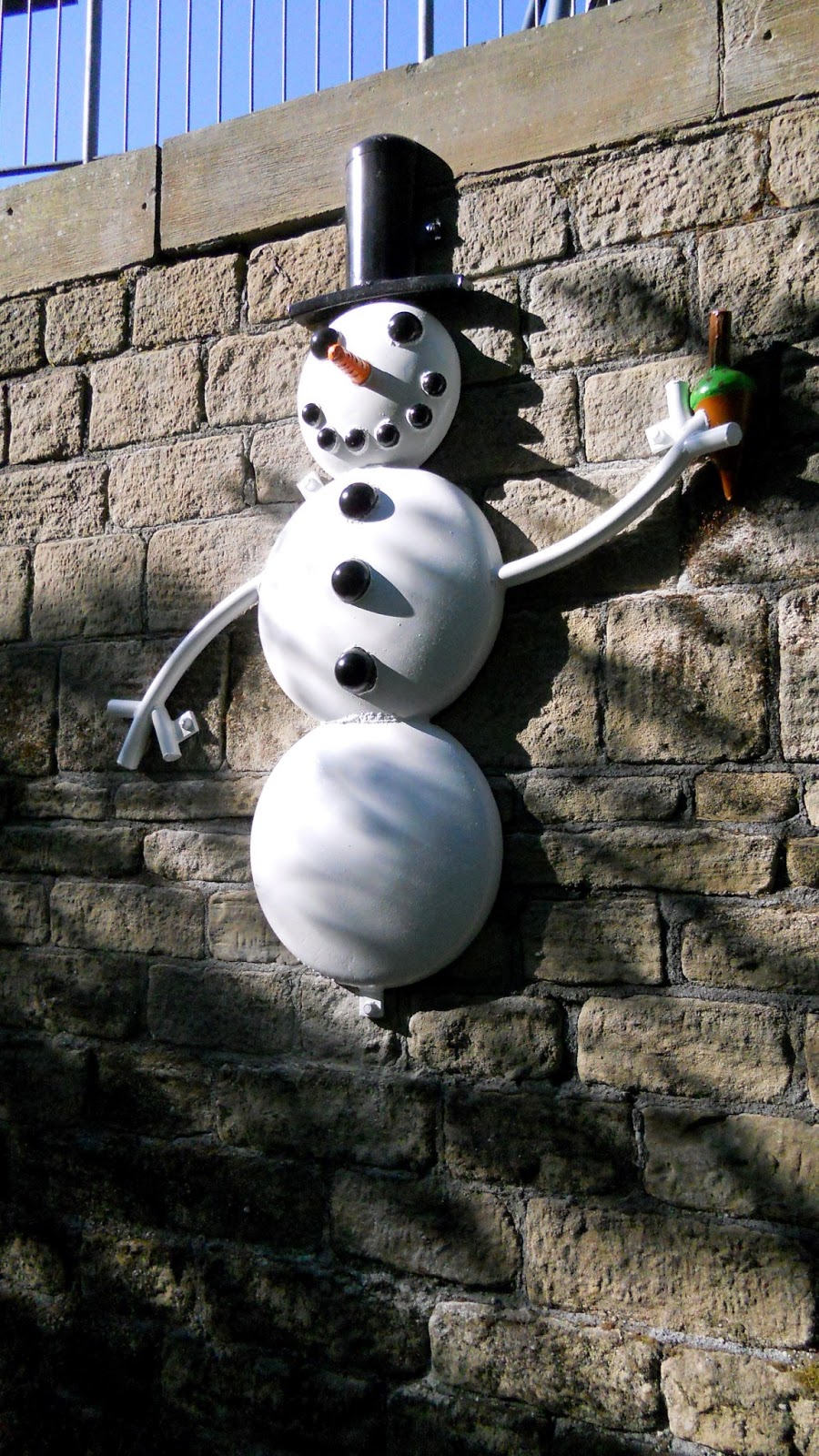
There is an Octopus, Pirate Ship, Salt pot slug, Fish & drawers, Fish, Cat bath,
Bird, Skater frog, Snowman, Dog, Alpaca, Submarine, Frog on leaf, and Dinghy dog.

I am puzzled by these sculptures supposedly being about the Shipley/Saltaire area, as the only one amongst them is the Alpaca.  I guess anything is possible when it comes to children's imagination, although I think they could have had a little more "direction" in what the area is really about.

Wonder what other residents think about it?


Tuesday, 7 May 2013

York


Out trip to York on 5 May 2013
 
The Romans founded the city of York. They invaded Yorkshire in 71 AD and built a fort between the rivers Ouse and Foss. By the mid 2nd century a small town grew up by the fort. Craftsmen and merchants came to live there because the soldiers in the fort provided a market for their goods and ships could sail up the River Ouse.
The Roman name for York was Eboracum, which may be derived from Celtic words meaning the place with yew trees. By the early 3rd century Roman York was protected by a stone wall. In the town there were public buildings such as a baths. Rich people lived in very comfortable houses with mosaic floors.
However in the 4th century Roman civilisation began to break down. The last Roman soldiers left Britain in 407 AD and afterwards Roman towns were abandoned and they fell into ruins.

After the Romans departed York was probably abandoned or nearly abandoned and the old Roman buildings fell into ruins. There may have been a few people living inside the walls farming the land outside but York ceased to be a town.
In 627 a bishop of York was appointed. A cathedral was built inside the walls of the Roman town and a bishop's palace was probably built there as well. It is possible the local Anglo Saxon king built a royal palace inside the Roman walls.
Then in the 8th and 9th centuries the town of York revived. Its position made it an ideal place for trade and so craftsmen came to live there. They probably started weekly markets and goods such as pottery were brought by ship from Europe. By the middle of the 9th century York was a flourishing town once again. However it was probably much smaller than the Roman town with a population of only about 2,000. It is believed that the town was called Eofer's wic (wic meant trading place). The Danes changed its name to Jorvik.
Then in 866 the Vikings conquered northern England and York became the capital of a new Viking kingdom. Viking York boomed and it grew much larger. In the town wool was woven. There were blacksmiths and potters. Other craftsmen made combs from bone and antler. The Danish word for street was gata, which in time became corrupted to 'gate'. Coppergate was cooper gata.
 
By the time of the Norman Conquest in 1066 York was booming and it probably had a population of 9,000 or 10,000.
William the Conqueror built a wooden castle in York. However in 1069 the north of England rebelled. The Normans in the castle were massacred. However William captured York and sacked it. He also built a second wooden castle to control the town.
In 1190 a horrific massacre took place in York. Jews took refuge in the main castle. Some committed suicide. The townspeople set fire to the castle and the rest were persuaded to surrender but they were murdered anyway. Cliffords Tower was built in the mid-13th century to replace the keep of the main castle which had been burned in 1190.
Then in 1212 King John gave York a charter, which allowed the city self-government.

Carlisle Cathedral, Cumbria


The Fractry (Kitchen House) in the grounds of the Cathedral
 
 
The Cathedral Church of the Holy and Undivided Trinity, otherwise called Carlisle Cathedral, is the seat of the Anglican Bishop of Carlisle. It is located in Carlisle, in Cumbria, North West England. It was founded as an Augustinian priory and became a cathedral in 1133.[1]
Carlisle, because of heavy losses to its fabric, is the second smallest (after Oxford), of England's ancient cathedrals. Its notable features include some fine figurative stone carving, a set of medieval choir stalls and the largest window in the Flowing Decorated Gothic style in England.[2]


Monday, 6 May 2013

Settle to Carlisle Train Trip

Today we took a trip on the Settle to Carlisle train line, one of the most travelled in England. The views of the countryside as we sped along were fantastic.
 
The Settle - Carlisle Railway is without doubt one of Britain's most spectacular railway lines.
 
It was the last great mainline railway to be built in this country. Completed for passenger travel in 1876 by the Midland Railway Company, it had taken six years to build. For the 19th century engineers, the landscape presented a tremendous challenge to their ingenuity, skills and abilities.

Consisting of 72 miles of track with 17 major viaducts spanning the ravines and 14 tunnels, the line was constructed by men who lived a harsh life in shanty towns, with little to supplement their manpower except dynamite.
Advertised as the most picturesque route to Scotland, the Victorian and Edwardian travelling public took it to their hearts.

Occasionally private operators organise steam-hauled trains on the line.

There are -
  • 380 numbered bridges (including 14 tunnels & 21 viaducts)
  • 20 stations (11 open, 9 closed)
  • 13 signal boxes (10 operational, 2 preserved (Armathwaite and Settle), 1 disused & derelict (Little Salkeld))
  • approximately 150 railway workers’ houses (all now in private ownership)
  • approximately 100 line-side huts (all disused and in various stages of decay)
  • one aqueduct (recently restored)
Most of the line, from Carlisle to Dent, is in Cumbria, with the section between Ribblehead and Settle in North Yorkshire.

Saturday, 4 May 2013

Doncaster Yorkshire


Today 4th May 2013, we visited the City of Doncaster
 
Doncaster was founded approximately 71AD by the Romans who had a fort here , the fort was named Danum . The Romans left England in the 4th century.
The very first Roman fort in the area(approx 40AD) was located at Rossington Bridge just to the south of Doncaster. Rossington Bridge is locally known as Parrots Corner
Doncaster got its name from the Saxon word ceaster meaning fort and the area being called Don,the area was known as Don Ceaster, as time went on the name was shortened to Doncaster. The Saxons created the first settlement which later became Doncaster.
 

Saturday, 27 April 2013

Saltaire Vegetable Swap


Vicars Café
Vegetable Swap
 
Calling green-fingered gardeners!..
 
Convert your Greens to Gorgeous Grub!
 
Swap your fresh produce for Vicars Vouchers in the VEG-EX Scheme.
 
The staff of Vicars Bistro on Victoria Road, Saltaire have come up with a fantastic idea.
They are hoping that their food with a heart scheme will bring together the community of Saltaire, enabling local gardeners, college students studying horticulture and anyone else in the area that my be growing their own vegetables to bring along their excess seasonal produce, and in return receive vouchers which can be spent in the bistro.
 
This young man, dressed as a carrot, was enjoying the sunshine as he walked Victoria Road handing out flyers advertising the vegetable swap.
 
He kindly let me take his photo.


Wednesday, 17 April 2013

Saltaire Heritage Weekend

Saltaire Heritage Weekend
          April 2013                                                                                              April 2013
 
 
The Saltaire Heritage Weekend has come and gone for 2013 and I must say that it did not have the same feel about it this time round. Last year the trees and flowers had begun to bloom and lots of visitors enjoyed the canal and Roberts Park activities.
 
This year, the number of visitors seemed to be lacking and the atmosphere around the canal and the park was rather flat. The trees are still bare and the skies still mostly grey, although we have had a little sunshine over the past few days.
 
Come on summer, it is time to shine in the beautiful Saltaire.

Tuesday, 5 March 2013

The Saltaire Busker

 
A Saltaire Busker
 
This gentleman can often be found busking beside the bridge over the canal on Victoria Road, and he certainly has a collection of different instruments that he plays.  A very colourful character in more ways than one I imagine.

Saturday, 26 January 2013

Saltaire Snowy Mist

 
Had more snow overnight, but a lovely sunny morning to take a walk through Roberts Park in Saltaire.  A snowy mist still hovered just above the ground for a little while, until it burnt off in the sunshine.  

Sunday, 20 January 2013

Saltaire in the snow

19 Jan 2013
 
The snow creating a pretty scene across Roberts Park towards the Boathouse Inn with Salts mill further in the background. Not too many folks braving the cold today.

Sunday, 30 December 2012

Saltaire Car Park


This is the proposed site for a 52 space pay and display car park in Saltaire between the canal and the river. I agree that there is a lack of parking available in Saltaire (just like everywhere else really) but this site is certainly NOT suitable.  The road is only wide enough for one car and it already causes havoc with residents of Riverside Apartments and staff of the NHS. Lets hope that the Bradford Council sees sense to deny the planning permission.

Wednesday, 26 December 2012

Saltaire Graffiti


Walking along the Leeds-Liverpool canal through Saltaire is never dull or boring... there is always something new or interesting to catch one's eye.  Today this little blue mermaid chalk graffiti seems to have appeared out of nowhere, I'm sure it is a recent addition to the stone wall, and quite pleasant to look at as well.  Not quite sure what "deny everything" means though !!

Friday, 21 December 2012

Chalgrove Oxfordshire

 
This photo was taken on our recent trip to the village of Chalgrove in Oxfordshire where some of my ancestors were born. This particular thatched roof cottage was once the home of my 3rd great grandfather Samuel Belson.  It was wonderful to visit this pretty little village and so exciting to find that the cottage still stands today.
 
 
CHALGROVE, a village and a parish in Thame district, Oxford. The village stands on an affluent of the Thame, 5 miles SW of Tetsworth, and 5½ NNE of wallingford r. station; and has a post office under Tetsworth. The parish includes also the liberty of Rufford. Acres, 2,364. Real property, £3,747. Pop., 549. Houses, 124. A skirmish was fought on Chalgrove Field, in 1643, between the royalists under Prince Rupert and the parliamentarians. 

Monday, 17 December 2012

Saltaire Canal


This image of the Leeds - Liverpool Canal was taken from the bridge above it at Saltaire.  This part of the Canal seems to freeze over quite easily, whereas on the other side it is flowing freely.  Being taken at 5.30pm, it looks like a black and white, but it was taken in colour.  I love the reflections of the trees here and there as it begins to thaw.

Wednesday, 5 December 2012

Saltaire - 2nd six months images


August
 

 July  
 

October
 

 September
 

December

 November
 
 
I have now completed my mission of taking a photo of the Leeds-Liverpool Canal at Saltaire on the same day of each month from approximately the same place on the canal for the year of 2012. The weather has been kind to me over the year, as it has never stopped me from venturing out on the 5th day of each month, and I cannot remember it even raining on those particular days. 
 
I think the coldest day of all was today. Such a lovely crisp morning, but the chilly wind sent me back inside very quickly.